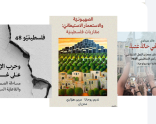

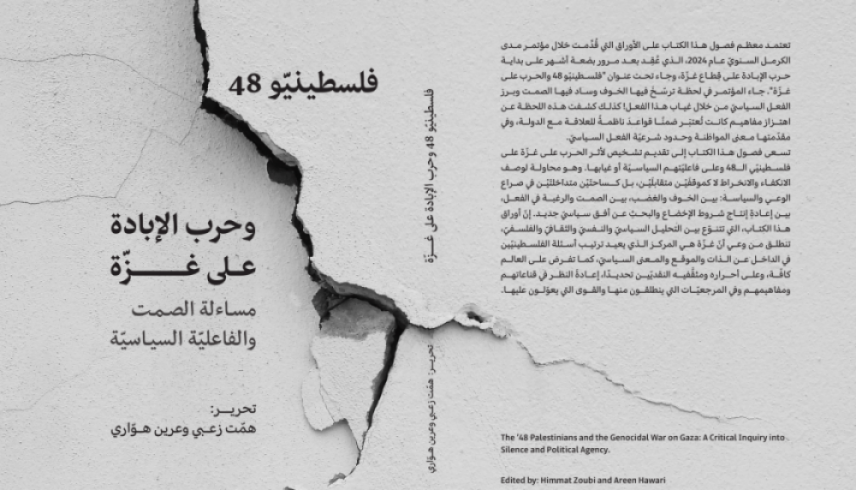


Mada al-Carmel – The Arab Center for Applied Social Research, has published a new book, edited by Himmat Zoubi and Areen Hawari, entitled, 1948 Palestinians and the Genocidal War on Gaza: Questioning Silence and Political Agency. This book is the outcome of Mada al-Carmel’s annual conference in 2024, which was held a few months after the outbreak of the genocidal war on the Gaza Strip. It arrives at a pivotal moment, one marked by widespread fear, pervasive silence, and a striking absence of political action.
Rather than an isolated incident, for 1948 Palestinians the war was a mirror reflecting the fragility of the foundations upon which their citizenship stands, the limitations of so-called integration, and the profound nature of the violence inherent in the very structure of the colonial state. While the ‘Gaza moment’ appears to portend the beginnings of a global epistemological, political, and intellectual transformation, it has also revealed a deep conceptual crisis among Palestinians within the Green Line: citizenship, remaining on the land, their distinctive status, and political agency—concepts that have for decades formed the framework for Palestinian action within the Green Line, are today being put to an existential test. It has also laid bare the limits of the political and intellectual response of Palestinians inside the Green Line to questions relating to their position toward and relationship with both Israel and the Palestinian cause, and to questioning their role and responsibility towards their people facing genocide and displacement.
This book, which contains a wide range of articles and studies that approach the Gaza moment from various political, psychological, cultural, and philosophical perspectives, strives to identify the impact of the war on Gaza on 1948 Palestinians and their political agency—or the lack thereof. It is an attempt to depict withdrawal and engagement not as two diametrically opposed positions, but as overlapping arenas in the struggle over consciousness and politics: between fear and anger, between silence and the desire to act, and between reproducing the conditions of subjugation and searching for a new political vision.
The book’s opening section begins with a testimony from the heart of Gaza by Gazan academic and researcher Dr. Elham Shamali. This is followed by a critical analysis of the structure of fear and silence among Palestinians inside the Green Line, written by Dr. Mohanad Mustafa, the academic director of Mada al-Carmel’s Graduate Student Support Program.
Section two of the book opens with a field analysis based on an opinion poll carried out by Mada al-Carmel. An essay written by Dr. Mtanes Shihadeh, director of Mada al-Carmel’s Israel Studies Program, reveals a society living at the intersection of moral rejection of genocide and an existential fear of the state, as well as a crisis-stricken political consciousness attempting to reconcile solidarity with survival. Habib Makhoul, a researcher at Mada al-Carmel, then offers a psycho-social examination of the deep structures that produce silence, through an astute intellectual analysis that questions the position of Palestinians inside the Green Line, caught between anger and fear, between Gaza and Nazareth, and between the oppressed and the colonizer. The section concludes with an essay penned by student activist Yousef Taha, who documents the largescale crackdown on the Palestinian student movement within the 1948 territories. It provides detailed information on disciplinary committees, expulsions, and incitement by parliamentarians and the media, and reveals how universities have been effectively transformed into security barracks and tools for controlling the political consciousness of young people.
In a section of peer-reviewed studies, Mohammad Awad, a lawyer and political activist, discusses Palestinians’ citizenship in Israel in a philosophical essay in which he employs the concepts of sovereignty and exception, drawing on the perspective of Schmitt and Agamben. From this standpoint, he argues that the war on Gaza was not an exceptional event in terms of the logic of the state, but rather an intensification of its enduring logic—the production of the Palestinian, in every location, as an enemy—and that Palestinians’ citizenship in Israel should be understood not as a civil contract but as a regime of permanent exception. Haneen Zoabi, a political activist and former Knesset Member for the National Democratic Assembly (Balad) party, then gives a critical reading of the dichotomy of integration and separation within the discourse of Palestinians inside the Green Line after October 7, 2023. She proposes an epistemic-political reading of that moment as an illuminating event that reorders the relationship of Palestinians inside the Green Line to the State of Israel and to their own political selves.
Jad Qadan, a PhD candidate in cultural sciences and linguistics, offers a cultural analysis of texts published on the genocide in the Gaza Strip in Palestinian cultural magazine Fusha between October 2023 and April 2024. He demonstrates that Palestinian culture did not merely reflect the event, but rather transformed into a site for practising life in the face of death. Hence writing itself becomes a symbolic burial ritual and a means of restoring dignity, as well as a space for documenting the ruptured time of genocide. Ghada Majadli, a researcher focusing on the intersection of health and politics, then addresses the situation of the 1948 Palestinians, specifically Palestinian doctors working in Israeli hospitals, from a sociological perspective, in a study she drafted for Mada al-Carmel after the conference. The study reveals how the Israeli healthcare system has been turned into a space of political and security control.
Despite the severity of the repression and the depth of subjugative policies, attempts by 1948 Palestinians to resist this structure, albeit in modest and limited forms, are not wholly absent from the essays that make up this book. The volume calls for a serious political and intellectual reassessment of the position of 1948 Palestinians within the continuing colonial project, and for a political and moral reconsideration of their role as Palestinians toward their wider people in the shadow of genocide. For the genocidal war has not only produced a crisis in political action, but has also exposed the profound flaws in the very tools with which we understand politics itself.

العنوان: