
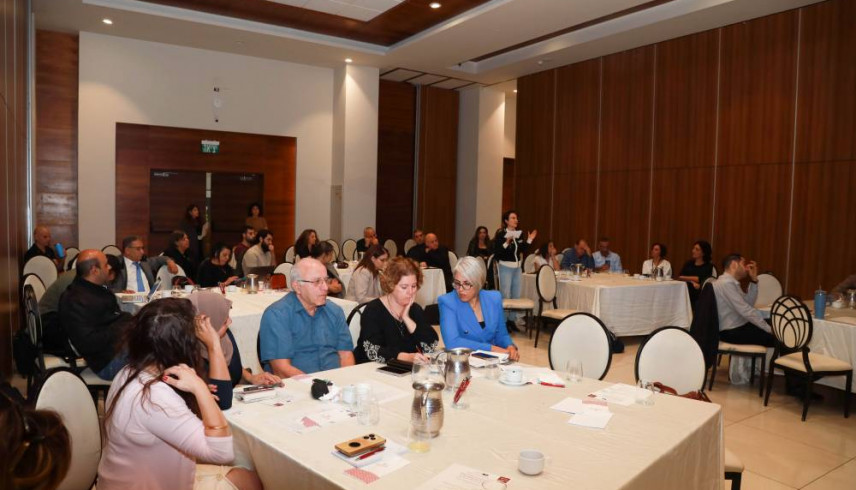


Mada al-Carmel – The Arab Center for Applied Social Studies has held its Annual Conference for 2025, under the title The War on Gaza and Rethinking the Role of Palestinians inside the Green Line: Society, Academia and Politics. The conference took place on 29 November 2025 in the city of Nazareth.
In her introductory remarks, Omnia Zoubi emphasized the fact that we are living through an unprecedented moment for Palestinians, one in which the war of genocide in Gaza, the settler-state project in the West Bank, and political persecution inside the Green Line intersect. She further stressed that we must, with courage, rethink our role as 1948 Palestinians, in terms of our agency, discourse, and behavior, and maintained that the current moment requires us to question silence and engagement, and to reassess the position and the moral and political responsibility of Palestinians inside the Green Line today.
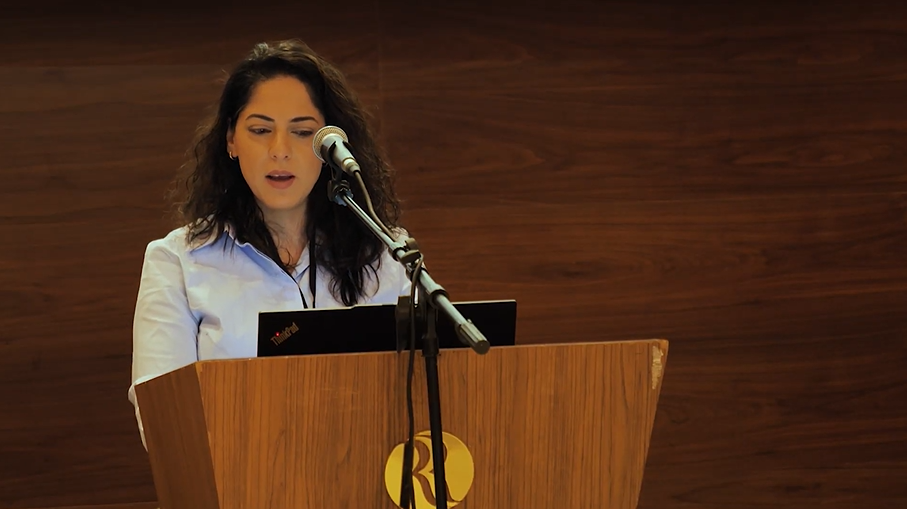
In a presentation entitled “Palestinians inside the Green Line: Between the Clarity of Genocide and the Uncertainty of Questions,” Dr. Areen Hawari, the General Director of Mada al-Carmel, emphasized that the present moment is characterized by the convergence of the blatant genocide unfolding in Gaza, and the confusion caused by questions that weigh heavily on the Palestinian reality as a whole. She addressed the ongoing war – and associated killings, starvation, and raids – as well as the systematic persecution, social breakdown, and rising crime rates experienced by Palestinians within Israel, all within a political context of diminished Palestinian and Arab capacity for action. She remarked that the current phase exposes the limitations of conventional analytical tools and faces Palestinians of 1948 with the urgent need to re-examine their relationship with Israel and with their own national project, and to understand their own position, role, and responsibilities in the shadow of the genocide. She also noted that, despite a relative decline in the discourse of fear and silence during the second year after the outbreak of the war, as well as the emergence of tentative movements and a growing political demand to ‘fight the genocide,’ this has not led to a serious collective reassessment of the question of 1948 Palestinians and the meaning of their citizenship. She emphasized that Gaza has become a reference point for renewed questions relating to the politics and specific positionality of 1948 Palestinians, and that academic, political, and cultural institutions must open up avenues for discussion about these questions.
Next came a presentation by Orouba Othman, a PhD candidate in the social sciences program at both Birzeit University and the Université Libre de Bruxelles (ULB), under joint supervision. Her presentation explored how Palestinians in the Gaza Strip develop a sense of the future and of time from within the structure of colonial genocide designed to suspend their existence between an inexorable present and a distant horizon. Yet, as Othman explained, it is precisely within this extremely limiting space that alternative practices of resilience (sumoud), hope, and future-oriented imaginings take shape, at once intersecting and mutually contradictory. She outlined the ways in which Gazans’ daily experiences of social pain become a productive site for the manifold future visions they hope for, and which carry their own dynamics for action and influence during the present time of genocide, fear, and overwhelming uncertainty that permeates every lived moment. Her talk sought to provide an analysis that diverges from dominant studies of trauma, which reduce pain/trauma to uniform pathological dimensions that are to be eliminated and expunged from the self, by emphasizing socio-anthropological analyses that capture the agency inherent to pain and emotions in general.
At the end of the opening session, director Aïda Kaadan gave a presentation about her short documentary film, Another Day Shall Come (2025), an audio-visual work depicting the suffering of oppressed Palestinians living in the 1948 territories while Israel perpetuates genocide in Gaza. The film features a collection of anonymous voices overlaid onto footage of scenes shot in Palestine over the course of two years of genocide, reflecting 76 years of deprivation, loss, and marginalization. During the session, the director screened a three-minute excerpt of the film.
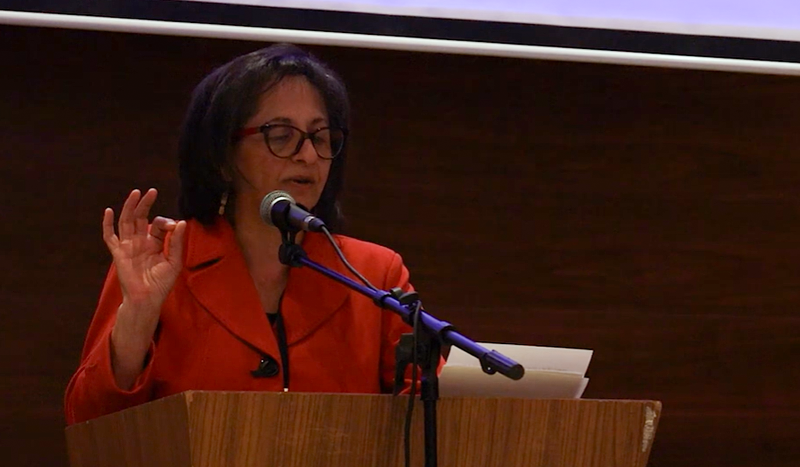
The first panel was dedicated to presenting and discussing “Palestinians inside the Green Line after Two Years of Genocidal War – Presentation and Discussion of the Results of Mada al-Carmel’s Public Opinion Poll,” and titled “Palestinians inside the Green Line after Two Years of Genocidal War.” It was opened and moderated by the director of the Israel Studies Program at Mada al-Carmel, Dr. Mtanes Shihadeh, who stressed the importance of context in interpreting any public opinion poll, and the limitations of such polls under the current circumstances of the Palestinian community inside the Green Line.
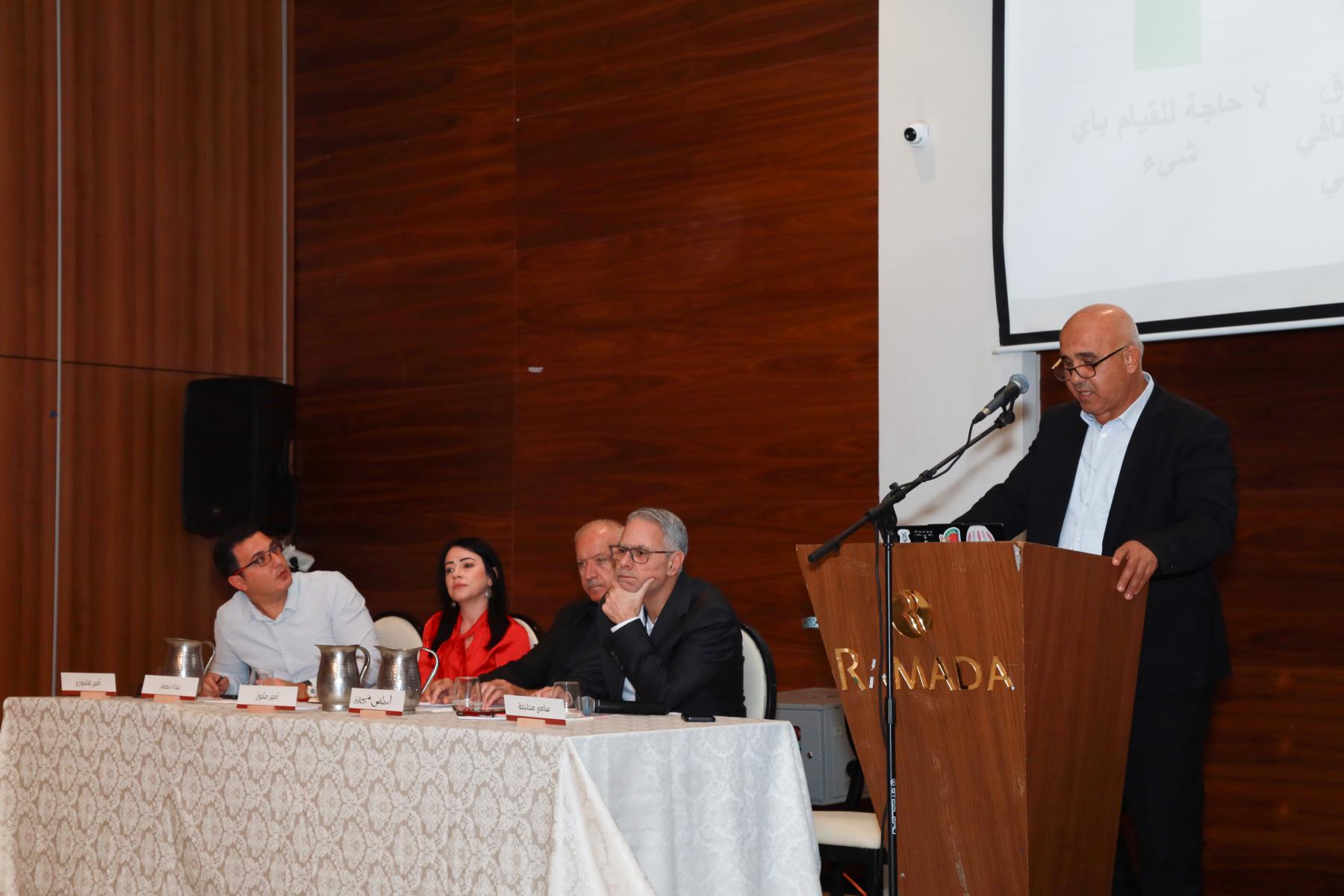
Dr. Sami Mahajneh presented the results of Mada al-Carmel’s 2025 survey, which was carried out during the war on Gaza. The survey was focused on two main areas: the political, social, and personal ramifications of the war for Palestinians in Israel; and their voting intentions in case elections are held, according to demographic and personal factors. The survey revealed that Palestinians inside the Green Line are developing a set of attitudes that serve their convoluted circumstances more than they reflect expectations of them. Most of them limit their role toward Gaza to giving material support – which aligns with the prevailing sense of fear – while their attitudes and behavior remain partly inconsistent. The survey also showed that the war compounded their sense of racism and discrimination, while simultaneously reinforcing their sense of national identity and belonging, and increasing disillusionment with leadership and political parties. Meanwhile, the political outlook remains unclear, with Gaza’s future uncertain, a political solution elusive, and mounting tensions between Arab and Jewish societies. In terms of political participation, the survey did not foresee a radical shift, predicting a return to a voter turnout rate of roughly 60%, as it has been over the last two decades – with a slight potential increase in case a joint list should be reformed – and the rate of abstention expected to remain between 30% and 40%.
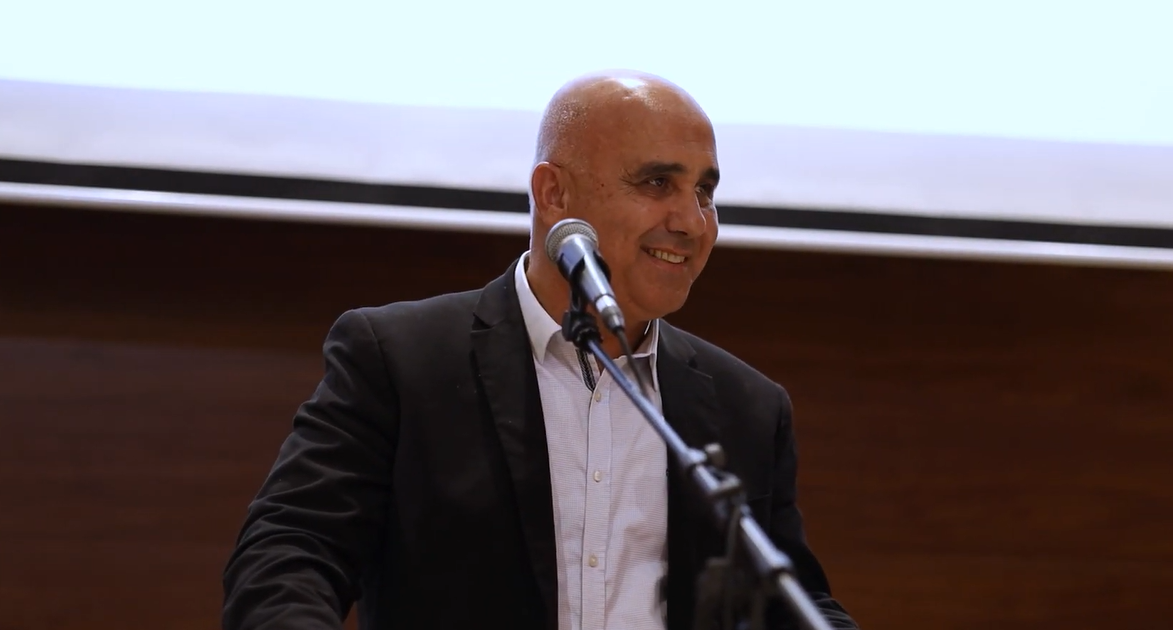
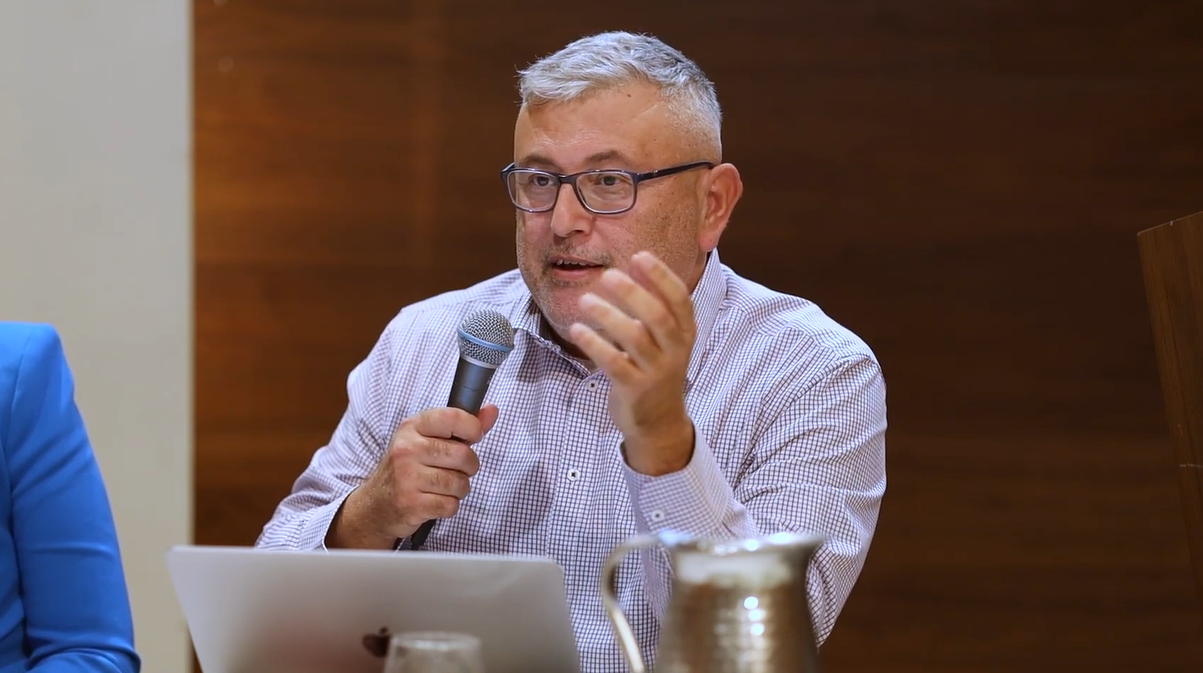
Commenting on the poll, attorney and political sociologist Dr. Amir Fakhoury spoke about intellectual and political shifts in the consciousness of Palestinians with Israeli citizenship following the war on Gaza, based on data from the field and contemporary interpretive approaches in the study of cultural nationalism. Fakhoury suggested that one should interpret the current reality through three main points: firstly, internal diversity in patterns of Palestinian nationalism within the framework of Israeli citizenship, which transcends the traditional dichotomy between ‘Israelization’ and ‘Palestinization.’ Second is the shift from a logic of ‘rescue,’ centered on the responsibility of the minority with Israeli citizenship toward the ‘mother nation,’ to a logic of ‘relief,’ based on unity in suffering and the erosion of the symbolic and existential privilege that previously characterized Palestinians inside the Green Line. Third is the gap between the profound structural transformation in the political situation and the apparent consistency of political behavior. Fakhoury concluded by stating that Israeli citizenship is no longer a space for protection or political action, but has become a kind of ‘multi-faceted trap’ that compels us to reimagine Palestinian existence outside the binary of state and citizenship.
In his talk, Ameer Makhoul, a political analyst and researcher at the Progress Center for Policies, stated that the data from the poll starkly reflect the impact of two years of repression, mirroring a decline in collective self-confidence, waning social cohesion, an inability to envision the future, and even a willingness among a quarter of Palestinians to consider emigration. He also pointed to the growing loss of trust in political movements, noting that an increasing willingness to participate in protests when they are protected and take place within a clear institutional framework, reflects the public’s need for a safe collective umbrella. Makhoul emphasized the need to incorporate the rise in crime into any analysis of the current reality, describing it as a state policy meant to contribute to fragmentation and the erosion of trust. He added that, in order to complete the picture, one must look at the internal crisis within Israel and at the broader Palestinian context, where moments of progress and setback feed off one another, while acknowledging the existential threat and the profound trauma that followed October 7, 2023 as significant realities. Makhoul further stressed that what is needed today is to convert this danger into challenges, to push for a wide-ranging dialogue between political movements and various other actors, and to start from what is feasible – such as countering the crime network – to pave the way for other major areas and issues.
Nidaa Nassar, director of NGO Baladna – Association for Arab Youth and a member of the political bureau of the National Democratic Assembly (Balad) party, observed that in order to analyze and comprehend the poll results, we must consider a range of interconnected factors and the socio-political context that shaped the complex findings. Such factors include the shifts in political discourse that have occurred since the founding of the Joint List, the effects of the Dignity Uprising of 2021 on people’s willingness to participate in elections, and the acute prevailing sense of fear, Israel’s use of an iron fist from the first moments of the war, and the upsurge in political persecution. She also interpreted and analyzed a number of specific results from the poll. This was followed by a discussion among the conference participants about the significance and implications of various aspects of the poll results.
This dialogue session, which was moderated by the educator, poet, and playwright Professor Ayman Agbaria, aimed to deepen the discussion on the production of Palestinian academic knowledge amid the ongoing genocidal war in Gaza, as a moment that sheds light on the limits and mechanisms of the dominant academic discourse. The session included a discussion of the phenomenon of ‘safe knowledge’ as a form of institutionalized ignorance production that subjects Palestinian researchers to practices of censorship, turning writing into an act of compliance and discipline. The session also touched on the relationship between the systems of ignorance that structure academia and the layers of ignorance that permeate Palestinian academic consciousness as it strives to express itself freely within a constrained academic space. It also contemplated possibilities for constructing critical, resistant knowledge that reconnects thought to the Palestinian reality. Participants in the dialogue included Dr. Samah al-Khatib-Ayoub, General Director of the Follow-Up Committee for Arab Education Issues; Neveen Ali-Saleh Darawshy, a lecturer and researcher at the Department of Social Work at Bar-Ilan University; and Jamal Mustafa, a master’s student in philosophy at Tel Aviv University, each of whom talked about their experiences in Israeli academia. They further discussed mechanisms of compliance and resistance as factors that shape the consciousness of Palestinian academic researchers and offered their own analyses of Israeli academia. The conference concluded with Professor Ayman Agbaria extending thanks to the participants and emphasizing the importance of holding such meetings between academics and activists.


العنوان: