
News/
أحداث / Urbicide in Palestinian Cities After the Nakba: Time, Rupture, and Remaking the Urban Space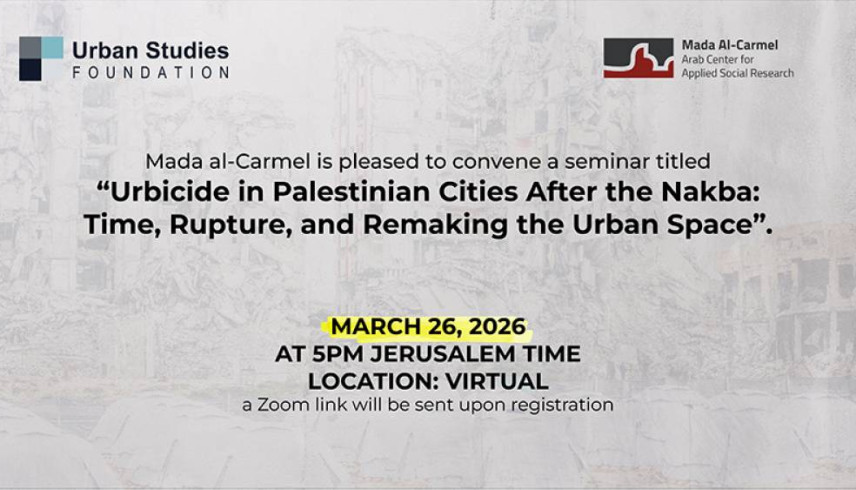


Date: March 26, 2026
Time: 5:00 PM Jerusalem Time
Place: Virtual – a Zoom link will be sent upon registration
This seminar is part of a series that began in Gaza, the site of the most intense manifestations of contemporary spatial violence, before moving to the geography of the 1948 Palestinians (Palestinians inside the Green Line)—in time as well as place—as a pivotal arena for understanding what happened to Palestinian cities after 1948. Here, the Nakba is approached as a foundational moment that reordered the urban landscape politically, socially, and legally, setting the cities in which Palestinians remained on a long journey of reorganization and redefinition.
The seminar focuses on cities such as Haifa, Yaffa (Jaffa), and al-Lydd (Lydda), which experienced ruptures in demographic structure, property ownership, political representation, and forms of local governance. This was followed by a gradual re-engineering of the space and the relationships that govern it through transformations in the municipal sphere, patterns of planning, land and housing management, and the redefinition of public space.
The seminar also raises the question of urban temporality: how is the past reordered, how is memory managed, and how is daily life reproduced amid a continuous spatial and political fracture? The session is part of a larger project that contemplates violence that operates across space, and reconsiders terminology itself, asking: how and to what extent do concepts such as “urbicide” enable a deeper understanding of what has happened and is continuing to happen in historical Palestinian cities, and do they help us to analyze the processes of deconstruction and re-engineering over the long term?
To register, please click here.
Presentations
Destruction and the Concept of Time within the Palestinian Urban Context
Yara Sa’di-Ibraheem, a Postdoctoral Researcher in Political and Human Geography at the University of Toronto, Canada.
“Who Lives There Down Under the Rubble?” A Visit to the city of al-Lydd Before the Upheaval
Tawfiq Da’adli, a Lecturer at the Department of Islamic and Middle Eastern Studies and the Department of Art History at the Hebrew University of Jerusalem.
Deconstructing Emerging Urbanity: Redrawing the Political Arena in Haifa After 1948
Himmat Zoubi, a Researcher in Urban Sociology at Mada al-Carmel.
The seminar will be moderated by Dr. Orwa Switat, a Postdoctoral Research Associate in Palestinian Studies at Brown University.
This project is funded by the Urban Studies Foundation’s (USF) Seminar Series Awards for 2025.
The seminar will be held in Arabic, with simultaneous interpretation in English available via Zoom.
Summary of Presentations
Destruction and the Concept of Time within the Palestinian Urban Context – Dr. Yara Sa’di-Ibraheem
Destruction and demolition are a continuous reality in Palestine, including in its cities, both before and after periods of war. Demolition is usually placed within the framework of global phenomena and theories related to economics and urban planning. In this presentation, I use the theme of demolition as an intellectual and analytical lens for understanding the urban reality in Palestine, by tracing the geographies and temporalities of demolition, the transformations it has undergone, and the ways it had been discussed and described. By tracing the temporality of demolition, I explore the following questions: How can “demolition” serve as a research methodology for thinking about cities such as Yaffa and Haifa in the present day? And how does a methodology such as this allow us to discuss prevailing global theories, as well as specific approaches employed when addressing the Palestinian case?
“Who Lives There Down Under the Rubble?” A Visit to the city of al-Lydd Before the Upheaval – Dr. Tawfiq Da’adli
This visit takes us back to the alleyways of the city of al-Lydd in the late 19th century, where we revisit some of its neighborhoods, such as the Hammam Quarter, including its markets and establishments. We will knock on the doors of some of the houses, get to know their residents, and perhaps even join them for a coffee in their sitting rooms. Before we part ways, we will try to understand what was behind the disappearance of their city from the face of the earth. It is an invitation to the imagination, and to touch something tangible that has vanished.
Deconstructing Emerging Urbanity: Redrawing the Political Arena in Haifa After 1948 – Dr. Himmat Zoubi
This presentation explores what happened in Haifa after 1948 as the dismantling of a modern political-urban trajectory that had been taking shape since the late Ottoman period, and gained in pace during the British Mandate. Far from a political vacuum, the Palestinian urban space was an arena that was taking shape through elected municipal councils, civic associations, trade unions, and other organizations that developed various forms of local governance and public participation.
The presentation examines the reconstitution of governance in the city following its occupation in 1948, through the establishment of the municipal council and dealings with the “Provisional Arab Committee,” trade unions, and associations. It then shows how this representative structure was disassembled or contained, in a manner that brought an end to independent Palestinian representation and restricted collective action. It suggests understanding this process as a pathway to de-urbanization, as one dimension of urbicide, in which it is not only the physical space that is targeted, but also the political and social sphere that makes the city and urbanity possible.
About the speakers:
Dr. Yara Sa’di-Ibraheem
Dr. Yara Sa’di-Ibraheem is a researcher in political and human geography at the Hearing Palestine Initiative, University of Toronto, Canada. Her research interests include indigenous geographies and temporalities, settler colonialism, neoliberal urbanism, and infrastructure in Palestine. She has published numerous academic articles on socio-political dimensions of infrastructure in colonial settings— principally telecommunications and playgrounds—as well as neoliberal planning under settler colonialism and the spatial-temporal experiences of indigenous communities.
Dr. Tawfiq Da’adli is a researcher in the fields of the history of Islamic art, Islamic antiquities, and local history. He is a lecturer in the Department of Islamic and Middle Eastern Studies and the Department of Art History at the Hebrew University of Jerusalem.
Dr. Himmat Zoubi is a researcher in urban sociology and feminist activist. Dr. Zoubi is a research associate at Mada al-Carmel – The Arab Center for Applied Social Research in Haifa, a Postdoctoral Fellow in the Europe in the Middle East – The Middle East in Europe (EUME) program in Berlin, Germany, and a research fellow at the Institute for Palestine Studies. She has a PhD in sociology and two master’s degrees, in Criminology and Gender Studies. Her research focuses on settler colonialism and its intersections with urban transformations, with a specific interest in the city as a space of domination, resistance, and knowledge production. Her research tackles questions of urbanization in Palestine; knowledge, place, and politics; and urban experiences. Recently, she has been engaged with questions relating to cities, neoliberalism, culture, and art, as instruments and discourses that are intertwined with systems of colonial control, as well as strategic spaces for resistance and political imagining. She is the director of the project Urbicide in Gaza: Spatial Violence, Reconstruction, and Resistance.
Dr. Orwa Switat is a Postdoctoral Research Associate in Palestinian Studies at the Center for Middle East Studies at Brown University. Switat is an urban planning scholar with degrees in philosophy, political science, and urban planning. He focuses on the status of groups in planning theory and practice. He has been a Religion and Public Life Fellow in Conflict and Peace at Harvard University and a visiting scholar in the Department of Urban and Environmental Policy and Planning at Tufts University. In his research, he integrates digitization and visualization with discourse and planning analysis to uncover hidden histories, restore lost heritages, spatialize oral histories, visualize counter-hegemonic narratives, and develop innovative restorative planning approaches.

العنوان: