




Urbicide – USF/
أحداث / Urbicide in Palestine – A Sociological, Historical and Architectural Approach (January 2026)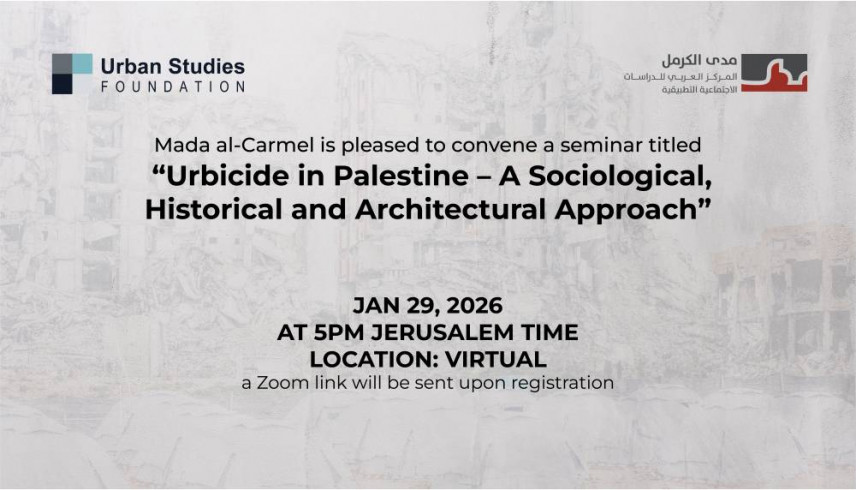


Mada al-Carmel is pleased to convene a seminar titled “Urbicide in Palestine – A Sociological, Historical and Architectural Approach.”
Date: January 29, 2026
Time: 17:00 (Jerusalem Time)
Location: Virtual – a Zoom link will be sent upon registration
To register, please click here.
The seminar will focus on the concept of urbicide in the Palestinian context, combining approaches from sociology, history, and architecture that put colonial planning at the center of the analysis. It will unpack how such planning is employed as a tool through which to deny the potential of the Palestinian city as a space of modernity, sovereignty, and the production of meaning. The seminar also seeks to show how colonial policies, by reshaping the urban space, attempt to undermine the material and symbolic conditions needed for the existence and continuity of the Palestinian city.
Presentations:
Urban and Architectural Genocide in Gaza: A Socio-Historical Reading
Abaher El-Sakka: Dean of the Faculty of Arts, Birzeit University
Disrupted Urbanity in Colonial Settlement: Planning as Urbicide
Abdullah Al Bayyari, an Independent Researcher, Academic, and Visiting Lecturer at the Institute for Palestine Studies and the American University in Cairo
Systematic Dispossession: Towards Urbicide in Jerusalem
Maha Samman: Urban planning researcher; author of The “Trans-Colonial Urban Space in Palestine."
The session will be moderated by Himmat Zoubi, a Researcher in Urban Sociology at Mada al-Carmel.
About the speakers:
Dr. Abaher El-Sakka was born in Gaza City. He currently serves as Dean of the Faculty of Arts at Birzeit University and Associate Professor in the Department of Social and Behavioral Science at Birzeit University. He holds a PhD in Sociology from Nantes Université, France. He is a graduate of the École Nationale Supérieure de Management des Organisations Sanitaires et Sociales, Saint-Étienne, France. He worked as a lecturer at Nantes Université from 1998 to 2006 and as a visiting professor at numerous universities in France and Belgium between 2009 and 2025. He has published numerous studies and academic articles in the fields of artistic social expressions, social movements, identity, memory, nationalism, urban studies, social policies, as well as the social sciences and their historiography. He is the author of several books and studies in Arabic, French, and English. He serves as Editor-in-Chief of Idafat, The Arab Journal of Sociology, and is President of the Palestinian Sociological and Anthropological Association, a member of the International Sociological Association, and Vice President of the Board of Trustees of the Arab Council for the Social Sciences.
Abdullah Al Bayyari is an independent researcher and academic at the Institute for Palestine Studies and a member of the editorial board of the Journal of Palestine Studies. He has a background in medicine. He is a visiting lecturer at the Institute for Applied Studies in Africa and the Middle East (BIAS-AME) in Egypt, and also at the American University in Cairo. He is a research fellow with the Remapping Narrative of Demolished Spaces in Haifa project at Harvard University’s School of Urban Planning and Design (USA), and a member of the Royal Geographical Society (UK), the Urban Studies Council (USA), and the Arab Council for the Social Sciences (Lebanon). He has published numerous academic and non-academic research papers and articles. He is also a researcher at Stanford University’s Humanities Center in the USA, and an editor at Palestinian cultural magazine Romman.
Dr. Maha Samman is Associate Professor of Architecture and Urban Planning at Al-Quds University. She is the author of the book Trans-Colonial Urban Space in Palestine (Routledge, 2013; in English). She holds a BA in Architecture from Birzeit University, an MA in Urban Planning from the Delft University of Technology, the Netherlands, and a PhD in Political Geography and Urban Policy from the University of Exeter, UK. Dr. Samman is also Editor-in-Chief of the Al-Quds Journal for Academic Research – The Humanities and Social Sciences Edition, published by Al-Quds University. She has published many articles in prestigious journals on subjects relating to architectural urban heritage and planning policies, particularly in Jerusalem. She was awarded a research grant by the Arab Council for the Social Sciences in 2018 and a research fellowship (joint) from the Palestinian American Research Center (PARC) in 2018. She has received several awards for excellence in scientific research.
Dr. Himmat Zoubi is a researcher in urban sociology and feminist activist. Dr. Zoubi is a research associate at Mada al-Carmel – The Arab Center for Applied Social Research in Haifa, a Postdoctoral Fellow in the Europe in the Middle East – The Middle East in Europe (EUME) program in Berlin, Germany, and a research fellow at the Institute for Palestine Studies. She has a PhD in sociology and two master’s degrees, in Criminology and Gender Studies. Her research focuses on settler colonialism and its intersections with urban transformations, with a specific interest in the city as a space of domination, resistance, and knowledge production. Her research tackles questions of urbanization in Palestine; knowledge, place, and politics; and urban experiences. Recently, she has been engaged with questions relating to cities, neoliberalism, culture, and art, as instruments and discourses that are intertwined with systems of colonial control, as well as strategic spaces for resistance and political imagining.
Interested persons are requested to register using this form.
This project is funded by the Urban Studies Foundation’s (USF) Seminar Series Awards for 2025.
Photo Credit: Yousef Zaanoun/Activestills



العنوان:


