
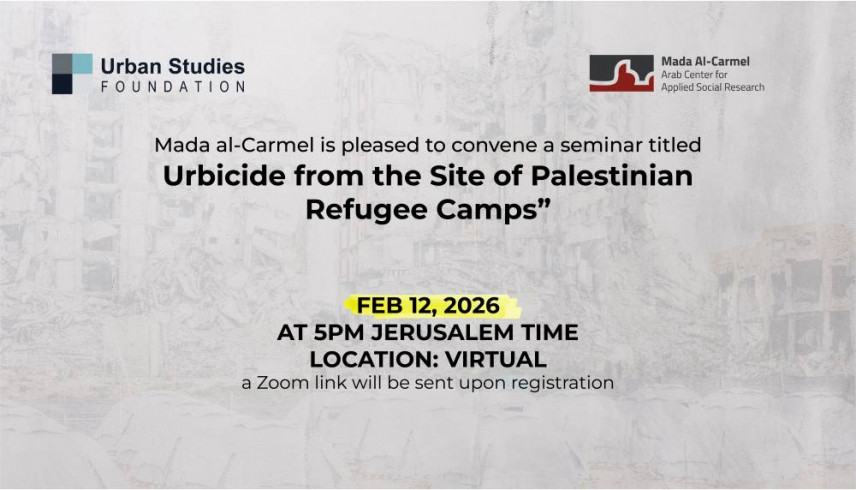


Mada al-Carmel is pleased to convene the second seminar in the series on “Urbicide in Gaza and the Palestinian Experience: Urbicide from the Site of Palestinian Refugee Camps”
Date: February 12, 2026
Time: 17:00 (Jerusalem Time)
Location: Virtual – a Zoom link will be sent upon registration
To register, please click here.
Presentations:
The Targeting of Palestinian Refugee Camps and Challenges of Reconstruction
Khaldun Bshara, an architect, restorer, and anthropologist the Department of Social and Behavioral Science at Birzeit University.
Concrete Conflict in Spatialization: The Refugee Camps in the Gaza Strip
Fatina Abreek-Zubiedat, an architect and Assistant Professor (Senior Lecturer) at the School of Architecture, Tel Aviv University
Constructing Collective Life Under Spatial Destruction
Sandi Hilal, an architect, artist, and educator, a cofounder of DAAR – Decolonizing Architecture Art Research
The session will be moderated by Ayham Dalal, an architect and urban planner the German University in Cairo.
The seminar will be held in Arabic, with English interpretation via Zoom.
This project is funded by the Urban Studies Foundation’s (USF) Seminar Series Awards for 2025.
Abstracts and Short Bios
Dr. Ayham Dalal is an architect and urban planner. His research interests include urban informality, collaborative design, and forced migration. He is the author of the book From Shelters to Dwellings: The Zaatari Refugee Camp, co-editor of the upcoming book Camps: Genealogies of Refugee Spaces in the Levant, and co-director of the award-winning film 13 Square Meters. He has a PhD from the Technische Universität Berlin, and has been a visiting fellow at academic institutions in Germany, France, the UK and USA. He is currently a Lecturer in Architecture and Urban Design at the German University in Cairo.
---
The Targeting of Palestinian Refugee Camps and Challenges of Reconstruction
This talk approaches the Palestinian refugee camps as liminal spaces in which the temporary intersects with the permanent, violence with memory, and humanitarian aid with politics. Since the Nakba, the refugee camp has been shaped by a humanitarian-colonial logic that seeks to manage life in a state of open-ended displacement. The camps and UNRWA have therefore constituted structures for administering – as opposed to ending – the delayed return. However, over time this temporary space has become a site for the production of political consciousness and resistance, which in turn has made it a constant target for regional and Israeli violence. Dr. Bshara argues that the destruction of the camps (especially after the “Al-Aqsa Flood” of October 7, 2023) and their reconstruction (after successive waves of demolition) are not anomalous events. Rather, they are two mutually complementary processes in a struggle over meaning: a struggle between a camp that is intended to be erased as a political remnant of forced displacement and evidence of the failure of dedicated international mechanisms, and a camp that is rebuilt as an act of resistance, and that reaffirms collective memory and the right of return through spatial practices (both material and immaterial). Reconstruction in this context can thus be understood as a human-political act that reproduces the ambiguous relationship between space, violence, and delayed redemption.
Dr. Khaldun Bshara is an architect, restorer, and anthropologist. He currently works in the Department of Social and Behavioral Science at Birzeit University and serves as director of the university’s museum. He is also Editor-in-Chief of the publication Jerusalem Quarterly and a former director of the Riwaq Center.
--
Concrete Conflict in Spatialization: The Refugee Camps in the Gaza Strip.
In this talk, Fatina Abreek-Zubiedat argues that the current erasure of the refugee camps in the Gaza Strip and the dehumanization of their inhabitants cannot be framed as “urbicide” without examining the historical dynamics of architectural and urban design that shaped the development and destruction of these camps. After the Israeli occupation of the Gaza Strip, urbicide – which is rooted largely in the logics of “classical” counterinsurgency – was structurally enacted as part of demographic colonization and militarization of the refugee camps, under the leadership of a sociological-settler cohort. However, at least until Oslo, this process of urbicide was contested by the development approach led by socio-economists. The latter approach was integral to economic integration and exploitation, and was grounded in broader regional development plans that reframed humanitarianism as the salvation of the global poor and treated refugees as a new Third World class in need of social and cultural management. Arguing for the future of the camps, therefore, requires unravelling the spatial and cultural complexities of elimination and modernization – or resolving the tension between the cultural violence of development and the physical negation of development, which both aim to nullify the refugees’ “right of return,” using different means. This history must be uncovered despite efforts to erase it, since power is founded upon a negation of the past.
Dr. Fatina Abreek-Zubiedat is an architect and Assistant Professor (Senior Lecturer) at the School of Architecture, Tel Aviv University, where she leads the Spaces-in-Transition Research Lab. She received her PhD with highest distinction in 2018 from the Technion–Israel Institute of Technology in Haifa and completed her postdoctoral fellowship at ETH Zurich. She is a member of the editorial team of the peer-reviewed International Journal of Islamic Architecture.
Her research focuses on aid-driven development and humanitarianism in the Global South; the cross-cultural spatial positioning of human and non-human forced migration; infrastructures of poverty; and food insecurity in fragmented regions. Her work has been published in leading peer-reviewed journals and edited volumes, including Environment and Planning C, D, and E; the Journal of Refugee Studies; Ethnic and Racial Studies; City; Citizenship Studies; and Rethinking History. She recently co-edited the special issue Colonial Pasts, Alternative Futures: Cultural Dynamics of Climate Change Resettlement and Inhabitation in the Global South.
Her work has received several prestigious awards and grants, including the Rothschild Fellowship, the Neubauer Fellowship, the Israel Science Foundation (ISF) grant, the VATAT Fellowship for Arabs, and the Azrieli Prize. Her book, A Territory in Conflict: Eras of Development and Urban Architecture in Gaza, published by the University of Pittsburgh Press (2025), was awarded the Graham Foundation Prize.
--
Constructing Collective Life Under Spatial Destruction
This talk examines spatial destruction as a condition that is shaped by the Israeli colonial regime’s systematic targeting of the material, political, and social foundations of collective life. Focusing on everyday spatial practices such as learning, hosting, cooking, and caregiving, it argues that construction itself can become a destructive force when collective life is displaced from its central role in shaping space.
Sandi Hilal is an architect, artist, and educator whose work engages architecture, art, and collective life in contexts shaped by displacement, statelessness, and migration. She is a cofounder of DAAR – Decolonizing Architecture Art Research, an architectural and artistic practice developed through long-term collaborations and shared forms of life. Through projects and pedagogical initiatives, her work examines learning, hosting, and spatial use as collective practices that challenge dominant frameworks of space, heritage, and preservation, and generate knowledge grounded in lived experience.

العنوان: