




Urbicide – USF/
أحداث / First session in the seminar series “Urbicide in Gaza: Spatial Violence, Reconstruction, and Resistance” (January 2026)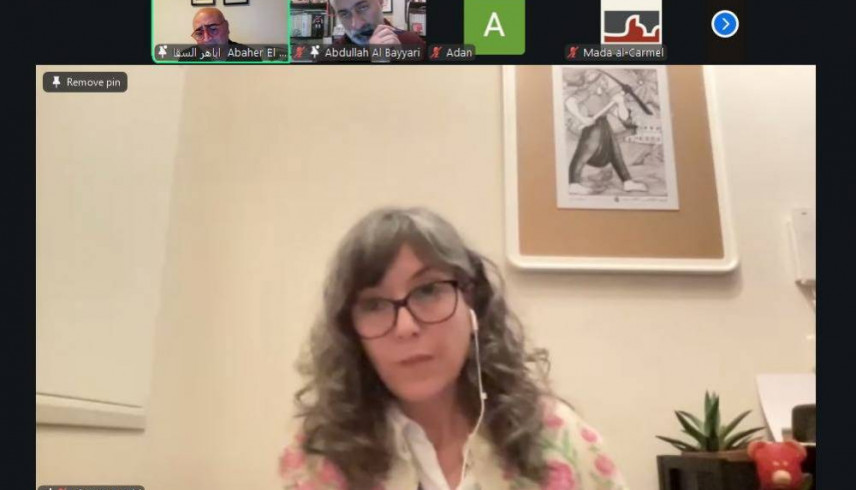


The first session in the seminar series “Urbicide in Gaza: Spatial Violence, Reconstruction, and Resistance” was held virtually via Zoom on January 29, 2026, with more than 150 participants from various countries around the world.
Dr. Himmat Zoubi, the project director and a research associate at Mada al-Carmel, gave the opening remarks in which she provided a theoretical framing of the project, explaining its background, main questions and themes, and positioned it within a critical epistemological debate about spatial violence and the destruction of the urban environment as systematic political practices. She emphasized that what has taken place in Gaza since October 2023 cannot be comprehended solely through the scale of the destruction or the number of casualties, and nor can it be reduced to purely humanitarian terms; rather, it constitutes a pattern of violence that operates across space and targets the conditions of collective life itself. In her view, it entails not only physical elimination, but also the imposition of new conditions of life that assimilate the effects of the devastation into a new political and spatial order that attempts to preclude recovery and reproduction.
Dr. Zoubi clarified that while the project’s point of departure is Gaza, as the primary site of this violence today, it also connects what is happening there to the longer history of colonial policies that have targeted Palestinian urban environments since 1948, through erasure, re-planning, dispossession, and the bureaucratic and security-based governance of life. The project situates this analysis within a global field of scholarship, while also emphasizing the imperative to produce knowledge derived from the Palestinian experience and that engages with global debates without being constrained by them.
Zoubi then reflected on the decision to translate the concept of ‘urbicide’ into Arabic as ʾibāda ʿumrāniyya (meaning urban annihilation), considering prevalent translations – such as ʾibādat al-madīna (annihilation of the city) and ʾibāda madīniyya (the targeting of urbanity as a way of life) – to be limited in that they restrict understanding of violence either to the city as a spatial formation or to urban living as a way of life. In contrast, she explained, the concept of ʿumrān in terms of its linguistic and intellectual roots – in particular in the Arab intellectual tradition of Ibn Khaldun – refers to human society itself as a condition for stability and structuring life within a place, which may include the city, village, camp, and any other form of organized habitation. From this viewpoint, the translation ʾibāda ʿumrāniyya allows for an understanding of violence as the deliberate targeting of the conditions of collective life and the possibility of its reproduction, and not merely the destruction of buildings or a way of life. Zoubi emphasized that such an understanding provides us with an analytical framework through which to approach what is occurring in Gaza today, as the nature of the current violence cannot be grasped through narrow concepts, but requires a concept that can capture the destruction of the conditions of habitation, stability, continuity, and the reconstruction of life itself, stating that this approach frames her understanding of the project as a whole.
.jpg)
In a presentation titled, “Urban and Architectural Genocide in Gaza: A Socio-Historical Reading,” Dr. Abaher El-Sakka, Dean of the Faculty of Arts at Birzeit University, traced the socio-history of episodes of urban and architectural annihilation that the Gaza District underwent nearly a century ago, focusing on fundamental transformations from 1948 that profoundly altered the urban and architectural landscape of Gaza City. In examining the various waves of destruction inflicted upon Gaza City, El-Sakka also discussed the capacity of Gazan society to survive, sustained by a network of social relationships that have enabled its people to endure.
Addressing the war of genocide on Gaza that began in October 2023, which he perceived as different from all those that preceded it, El-Sakka focused on the targeting of public spaces, as well as private and intimate spaces, including targeting of the family, which, he argued, has led to the erasure from the civil registry of thousands of families in their entirety. El-Sakka stated that the annihilation of places – homes, cemeteries, historical landmarks, and high-rise residential blocks – and the burning down of houses that the occupation army was unable to demolish, is a form of systematic targeting aimed at obliterating memory itself. He added that the ongoing bombing, demolition, and arson today seeks to undermine the capacity for shared living, mutual support, and consequently human dignity and the integrity of the family. Indeed, it is an attempt to erase the very idea of life itself, as well as the memory of the city.
.jpg)
The second talk, on “Disrupted Urbanity in Colonial Settlement: Planning as Urbicide,” was delivered by researcher and academic Abdullah Al Bayyari. It began from the premise that urbicide is a structural colonial process that is not restricted to the physical destruction of the built environment, but also seeks to deny the possibility of the Palestinian collective becoming a modern urban community able to produce its own urban environment, meanings, and sovereignty. He demonstrated how colonial planning is used as a foundational moment of demolition, erasure, and exclusion, in which planning itself becomes a mechanism of annihilation, and space a means of subjugating the collective and disrupting its temporal continuity. Al-Bayyari elaborated on Gaza as the clearest example of this pattern, whereby policies of bombardment, blockade, and functional dismantling intersect with the freezing of time, to halt cumulative development and prevent self-reorganization. In this way, time itself transforms into a tool of war that hastens death and slows the course of life. He emphasized that Gaza is not an exception, but a condensed moment within a broader continuum of colonial planning schemes, as manifested in Yaffa (Jaffa), the West Bank, Bir al-Sab‘ (Be’er Sheva), and elsewhere, schemes that produce a fragmented urban space that thwarts the emergence of a sovereign Palestinian domain. In his conclusion, Al-Bayyari introduced the concept of urbicide as a critical, anti-colonial approach to reinterpreting urban policies as tools of domination, and at the same time as a framework for contemplating a form of counter-urban agency that is emerging from the destruction and erasure, challenging notions of modernity, the city, and humanity.
.jpg)
The presentations were followed by a discussion with audience members that covered conceptual, political, and planning issues related to the ideas of urbicide and spatial violence, and the possibilities of reconstruction and resistance.
This seminar is part of the “Urbicide in Gaza: Spatial Violence, Reconstruction, and Resistance” series, and is funded by the Urban Studies Foundation (USF).
For details of forthcoming seminars, click here
To watch a recording of the seminar, click here
For more information about the project, click here


العنوان:


