




Urbicide – USF/
أحداث / Second session in the series “Urbicide in Gaza” │ Urbicide from the Standpoint of the Palestinian Refugee Camps (February 2026)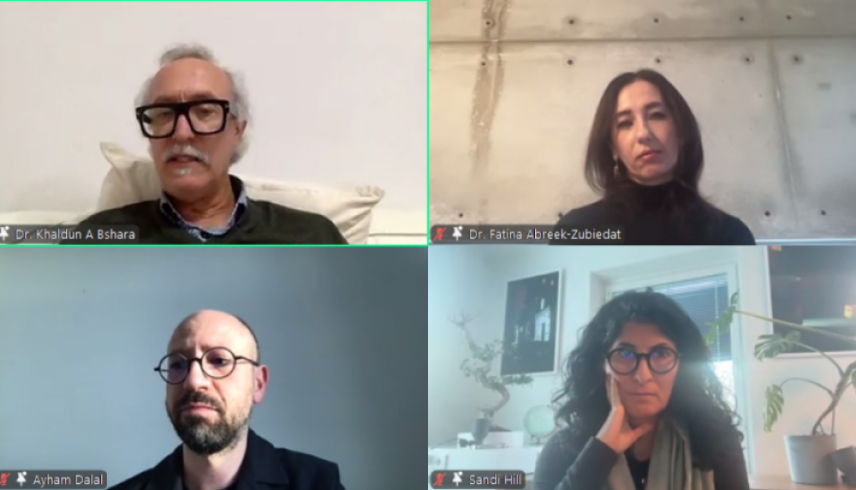


Mada al-Carmel – The Arab Center for Applied Social Research held the second session in its seminar series “Urban Genocide in Gaza: Spatial Violence, Reconstruction, and Resistance” on February 12, 2026. The session addressed the theme of “Urbicide from the Standpoint of the Palestinian Refugee Camps.”
Architect Dr. Ayham Dalal opened the seminar, remarking that the refugee camps that were established in the aftermath of the Nakba in 1948 embody a contradiction between their existence as temporary shelters and their transformation into sustainable urban spaces that hold collective memory, stories, and identities, turning the refugee into a city-builder in possession of the agency and capability to remake their place. His opening remarks raised fundamental questions about how to invest the knowledge and memory inherent to these camps in thinking about the future of the Gaza Strip, to go beyond mere physical construction toward the preservation of the historical and social value of the Palestinian urban sphere.
Architect and anthropologist Dr. Khaldun Bshara described the relationship to the camp as a form of impossible love, torn between the refugee’s attachment to the physical existence of the camp, as a living testament to the Nakba and a guarantee of the right of return, and the need to improve the living conditions of the camp’s residents in order to move beyond the logic of temporariness. Dr. Bshara described how the refugees reproduced the villages from which they were displaced inside the camp by organizing neighborhoods along familial and geographical lines, thereby transforming the camp into a spatial map of historical Palestine. He emphasized that the camp has become a center of revolutionary consciousness and wellspring of resistance, which has made it a target for systematic destruction aimed at enforcing “modern arrangements” that facilitate military control while eroding traditional ties. In concluding, he stressed that the refugee camp has generated a distinctly Palestinian architecture that emerges from memory and necessity, and that its reconstruction must be a process that involves the restoration of identity and place. Dr. Bshara also criticized the conventional term “reconstruction,” which often serves the interests of major powers, and advocated for the articulation of a Palestinian definition that links reconstruction to national rights.
Architect Dr. Fatina Abreek-Zubiedat examined the urban history of the Gaza Strip since 1967, criticizing the use of the term “urbicide” to describe the current war. She contended that the war constitutes an act of complete and arbitrary erasure and dehumanization that exceeds the mere destruction of buildings and of the city itself, to obliterate all systems of life. She discussed how Israel has historically attempted to depoliticize the Palestinian refugee issue through the use of economic development plans and housing projects, such as the Sheikh Radwan neighborhood, with the aim of turning the refugees into third-class citizens in exchange for relinquishing their political rights and refugee status. Dr. Abreek-Zubiedat also highlighted the stark contradiction between Israel’s current destruction of neighborhoods and infrastructure that it previously planned and developed itself. This occurred, she noted, following Israel’s withdrawal from the Strip in 2005, when its perception of the Gaza Strip shifted from a developmental lens to a purely security-focused lens, one that entirely disregards the place, its history and urban dynamics.
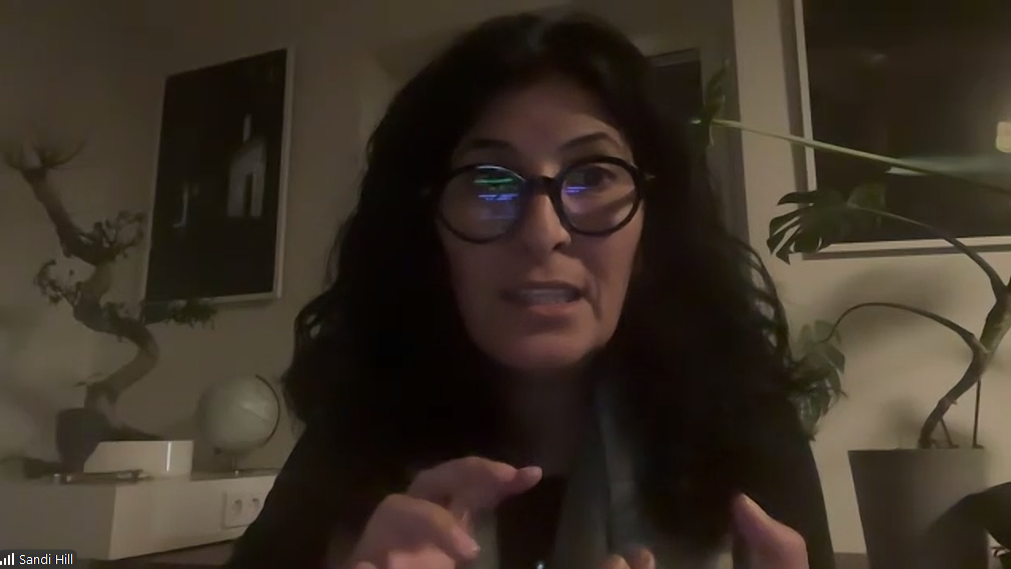
Architect Sandi Hilal then presented some lessons learned from reconstruction experiences in the Jenin, Nahr al-Bared, and Dheisheh refugee camps. She cautioned that any reconstruction in the Gaza Strip that ignores private property rights and the deep social connections between neighbors would be tantamount to “completing the project of genocide” through ostensibly “civilized” architectural means that in fact aim to unravel the social fabric. Hilal stressed that the camp represents the “right to exist and survive” in the present, as much as it embodies the “right of return” to the past. She referred to the example of the public square in Fawwar Refugee Camp, which was designed as a “roofless living room” that responds to residents’ understandings and needs, not formulaic Western models. Using the example of the “University in the Camp” initiative, she also underlined the importance of spatial knowledge as produced by refugees, calling for reconstruction to be a political and social act that stems from human connections and collective memory, in order to ensure the restitution of identity and dignity.
The meeting concluded with a Q&A session, in which the discussion focused on whether the destruction of the refugee camps sought to bring to an end their exceptional status and forcibly integrate them into the city, and on the future of the camp amid ongoing policies of demolition and reconstruction. There was also a debate on how to improve living conditions in the camps in a way that does not diminish their political significance in terms of refuge and the right of return, and whether reconstruction might be exploited as a way to force an end to the refugee issue and, consequently, the Palestinian issue as a whole.

العنوان:


