




News/
أحداث / Facing Urbicide: Spatial Reshaping and Practices of Resistance in the 1967 Occupied Palestinian Territories (June 2026)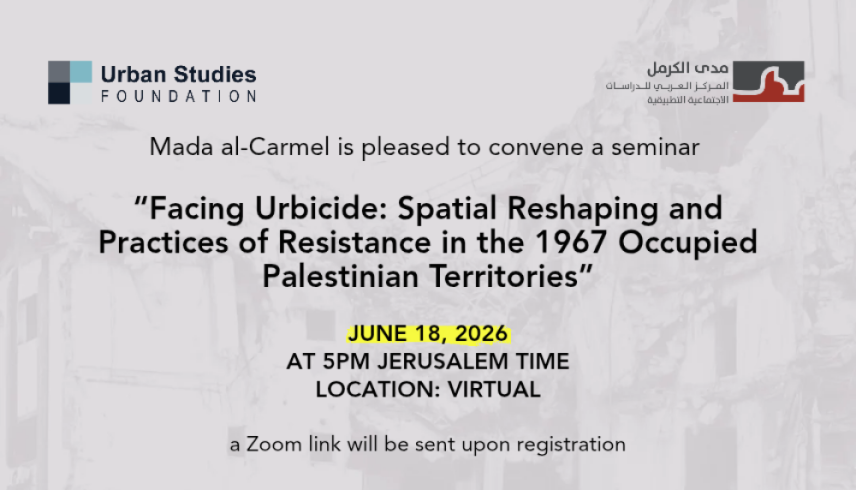


Mada al-Carmel is pleased to convene the fourth seminar in the series on “Urbicide in Gaza and the Palestinian Experience” titled "Facing Urbicide: Spatial Reshaping and Practices of Resistance in the 1967 Occupied Palestinian Territories"
Date: June 18, 2026
Time: 17:00 (Jerusalem Time)
Place: Virtual – a Zoom link will be sent upon registration
The seminar will be held in Arabic, with simultaneous interpretation into English via Zoom.
To register, please click here.
Previous sessions of the seminar approached “urbicide” as an ongoing colonial process that reshapes space and daily life, impacting the conditions of survival and the possibilities for continuing within the Palestinian city. The starting point of the series was the Gaza Strip, as the site of the most intense and visible manifestations of contemporary urbicide. It then moved on to different Palestinian geographies, from the Palestinian refugee camps as spaces of continual displacement and the reproduction of life under colonial violence, to post-Nakba Palestinian cities, asking questions related to time, rupture, and the remaking of the urban space.
In the fourth session, we return to the 1967 occupied Palestinian territories, specifically to cities in the West Bank, to approach urbicide from a different perspective and pose fundamental questions such as: how do Palestinian cities resist ongoing processes of erasure? And what forms of survival and life reproduction emerge within the colonized city?
The session focuses on the mechanisms of everyday resistance that arise within the Palestinian urban space, through spatial reproduction, the preservation of memory, livelihood-sustaining networks, housing practices, and continuity despite conditions of colonial depletion and control.
Presentations
“When Will You Open Damascus Gate?” How Jerusalem Reshaped its Center after the Nakba (1948–1967)"
Dr. Haneen Naamneh, Palestinian writer and researcher
"Ramallah in the Mid-Twentieth Century: Reproducing Place after the Nakba"
Lana Judeh, a Ramallah-based architect and researcher, and Raneem Ayyad, an architect and PhD candidate at Yale University, USA
"An Endless Alleyway: The Old City of Nablus and Practices of Survival and Resistance"
Dr. Abdalrahman Kittana, a postdoctoral researcher at Tampere University, Finland, and Assistant Professor of Architectural Engineering and Planning at Birzeit University, Palestine
The session will be moderated by Dr. Faiq Mari, Assistant Professor in the Department of Architectural Engineering and Planning at Birzeit University.
About the presentations
“When Will You Open Damascus Gate?” How Jerusalem Reshaped its Center after the Nakba (1948–1967) – Dr. Haneen Naamneh
This presentation examines the history of Arab Jerusalem between the Nakba (catastrophe) of 1948, and the Naksa (setback) of 1967, a period that has not received adequate attention in the field of Palestine studies compared to the focus on the city’s western neighborhoods that were occupied in 1948. In it, Dr. Naamneh explores some of the ways in which the city’s residents and municipality reshaped the city center and other urban areas under Jordanian rule following the loss of its economic and administrative center and its urban structure in the Israeli colonization of 1948. She focuses on transformations of the urban space in Jerusalem during the first decade after the Nakba, tracing the social and economic changes that the area extending from Damascus Gate to Herod’s Gate and Salah al-Din Street underwent as it was reshaped into a new center.
Ramallah in the Mid-Twentieth Century: Reproducing Place after the Nakba – Lana Judeh and Raneem Ayyad
Ramallah emerged as an urban center in the mid-twentieth century within the context of the various transformations that followed the Nakba. The settlement of thousands of displaced Palestinians who arrived from the Palestinian coast and Jerusalem played a role in the reshaping of its modern urban structure, including the materialization of a more diverse and distinct social fabric; the expansion of institutional structures, public services, and economic enterprises; and the appearance of new urban forms. Between the 1950s and its occupation in 1967, Ramallah was positioned within broader urban networks that stretched from Arab Jerusalem and Amman to other Arab capitals and the United States. This allowed for the reciprocal movement of people and capital, which was in turn reflected in several sectors, such as education and seasonal summer tourism.
How, then, did these transformations contribute to the production of new social and spatial relations in the city? How did they reshape social and political imaginaries within a dynamic urban landscape consisting of multiple visions and experiences? And how was this later reflected in the urban reality of the city following its occupation?
An Endless Alleyway: The Old City of Nablus and Practices of Survival and Resistance – Dr. Abdalrahman Kittana
The starting point of this presentation is the alleyways of the Old City of Nablus. From there, it explores the experience of the Israeli military invasion of 2002, as well as subsequent incursions, from an urban-social perspective. It seeks to comprehend how the urban fabric of the city enabled – or hindered – its inhabitants’ steadfastness (sumoud) and capacity to continue their lives in the face of aggression, and how this fabric responded to their basic needs to survive and secure the necessities of daily life. The presentation concludes with a brief analysis of how this urban space took shape historically, positioning it as a structural condition that allowed the Old City to become an incubator for practices of resistance and survival.
About the speakers
Dr. Haneen Naamneh
A writer and researcher whose research work focuses on the post-Nakba social history of Jerusalem, in particular the period between 1948 and 1967. She holds a PhD in Sociology from the London School of Economics (LSE) and is the recipient of an EUME postdoctoral research fellowship in Berlin. She is a contributing editor of the Jerusalem Quarterly.
Lana Judeh
Lana Judeh is an architect and researcher based in Ramallah. She taught at the Department of Architectural Engineering at Birzeit University between 2016 and 2024. Prior to this, she worked for several years at Riwaq on projects to revitalize the historic centers of Palestinian villages. Her academic and professional experience bridges the fields of architecture, urban studies, and cultural production, with a particular focus on the historical trajectories of Palestine’s built environment.
Raneem Ayyad
An architect and researcher who studies the history of social transformations and their relationship to the built environment in Palestine and its surroundings. She holds a Bachelor’s degree in Architecture from Birzeit University (2021), and is a doctoral candidate in the joint combined PhD program in Anthropology and Women’s, Gender, and Sexuality Studies at Yale University, USA.
Dr. Abdalrahman Kittana
A Palestinian academic, architect, and researcher who works at the intersections of urbanism, war, reconstruction, and the history of architecture. He is a postdoctoral researcher at Tampere University, Finland, and an Assistant Professor in the Department of Architectural Engineering and Planning at Birzeit University. He received his PhD from KU Leuven University in Belgium in 2020. He is a co-founder of the “Yalla Project” in Nablus, an interdisciplinary research initiative that works to regenerate urban space through participatory practice.
Dr. Faiq Mari
An Assistant Professor in the Department of Architectural Engineering and Planning at Birzeit University. His research focuses on the spatial aspect of the socio-economic and political struggle in Palestine, with a special interest in architecture and urban studies. He received his PhD from the Swiss Federal Institute of Technology in Zurich (ETH Zurich), and was awarded the Malcolm H. Kerr Award for best dissertation in the social sciences on the Middle East in 2025. He is a member of the editorial board of the peer-reviewed journal Architectural Histories and the magazine Arab Urbanism. His writings have been published on the Bab al-Wad website, the Journal of Palestine Studies, the International Labor and Working-Class History (ILWCH) journal, as well as in other journals and peer-reviewed volumes.
To register, please click here.


العنوان:


