




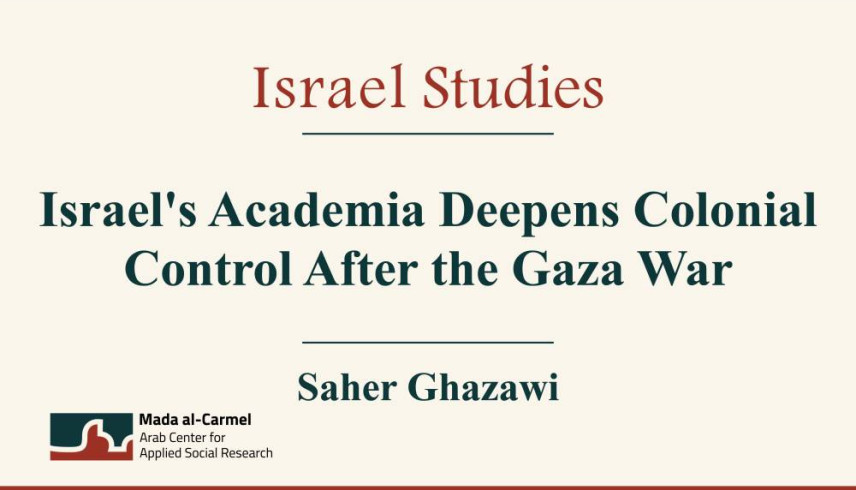


The Israel Studies Program at Mada al-Carmel – The Arab Center for Applied Social Research, has published a new paper titled “Israel’s Academia Deepens Colonial Control After the Gaza War,” authored by researcher and writer Dr. Saher Ghazzawi.
This study addresses the role of Israeli academia in the aftermath of the ceasefire in the Gaza Strip. It proceeds from the premise that academia is not just a supporting field of knowledge, but rather a structural actor that contributes to the production of a security-military discourse that lends colonial violence a technical veneer. The role it plays does not represent a qualitative shift as much as the entrenchment of an existing function, manifested in the reformulation of concepts of security, deterrence, and conflict management within an approach that focuses on efficiency, while relegating legal and political dimensions to the margins. The study is based on a critical analysis of research and studies published by Israeli and Western research centers, and reveals how the integration of the militarization of knowledge with the securitization of consciousness polices the boundaries of legitimate knowledge and erases the Palestinian as a knowing subject, thereby effectively preventing an alternative, liberating epistemic horizon from emerging.
The study concludes that the militarization of knowledge and the securitization of consciousness are not imposed on the academic sphere from the outside, but are embodied within it, through language, the modes of representing actors, and the boundaries of legitimate discourse. The practical examples analyzed in the study demonstrate that this role is not confined to the conceptual level, but extends to the structure of the academic field itself, where the conditions for knowledge production are re-ordered through the definition of what is considered legitimate knowledge, who has the right to produce it, and what is excluded from it.
In this context, the erasure of the Palestinian does not appear as an inadvertent absence, but rather as part of an epistemic structure that re-represents him through a security logic, transforming him into an object to be controlled instead of a meaning-producing subject. This development does not represent a qualitative shift so much as it reflects an expansion of the role historically played by Israeli academia in service of the settler-colonial project. However, the war on the Gaza Strip cast the intensified use of these mechanisms within the academic field into sharp relief, including the narrowing of the margins for criticism and the redefinition of academic legitimacy within a security-nationalist horizon.
To read the paper in English, click here.
To read the paper in Arabic, click here.

العنوان:


