
Urbicide – USF/
أحداث / Third session in the seminar series “Urbicide in Gaza” │ Urbicide in Palestinian Cities after the Nakba: Time, Rupture, and the Reshaping of the Urban Space (March 2026)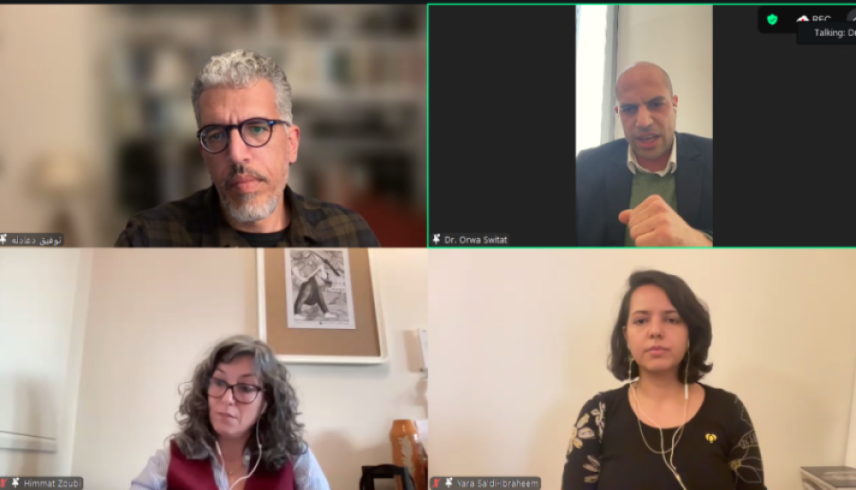


Mada al-Carmel – The Arab Center for Applied Social Research held the third session of its seminar series “Urbicide in Gaza: Spatial Violence, Reconstruction, and Resistance” on March 26, 2026, on the theme of “Urbicide in Palestinian Cities after the Nakba: Time, Rupture, and the Reshaping of the Urban Space”. The seminar was opened by Dr. Orwa Switat, a postdoctoral research associate in Palestinian Studies at Brown University. He stated that the series raises questions about the targeting of the conditions and foundations of urbanism as a right, memory, and public space, and not merely the destruction of stone buildings, given that urbicide entails the reordering of daily life through modes of control and uprooting.
Next, Dr. Yara Sa’di-Ibraheem, a postdoctoral researcher in political and human geography, gave a presentation on “Destruction and the Concept of Time within the Palestinian Urban Context,” in which she focused in particular on the cities of Yaffa, Haifa and Acre, contending that destruction is not a moment frozen in time, but a continuous process. Dr. Sa’di-Ibraheem also discussed the concept of re-occupation, describing how a place is re-occupied through the imposition colonial temporal narratives, as was the case in the Old City of Yaffa, which was transformed into an artists’ quarter along with the erasure of the Palestinian narrative. She also criticized neoliberal policies that turn destroyed or neglected Palestinian houses into commodities and high-end real estate, which leads to the privatization of the Palestinian imagination and distorts the original history of the place.
%20(1).png)
Dr. Himmat Zoubi, a researcher in urban sociology, then gave a presentation on “Deconstructing Emerging Urbanity: Redrawing the Political Arena in Haifa After 1948.” In it, she focused on the dismantling of emerging urbanity in the city of Haifa post 1948, arguing that the expulsion of residents was followed by a deliberate and systematic process of destruction targeting forms of political representation and organisation among the Palestinians who remained. She explained how they were subjected to a preconditioned security logic that made meaningful political action impossible, and how the systems of mediation and clientelism replaced elected Palestinian representative institutions, which in turn led to de-urbanization as a structural component of the settlement project. Dr. Zoubi emphasized that the distortion of the political arena was not a side-effect of the Nakba, but a means of remaking political space and action in a manner that serves colonial control.
.png)
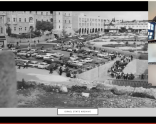
A presentation was then given by Dr. Tawfiq Da’adli, a lecturer in the Department of Islamic and Middle Eastern Studies and the Department of Art History at the Hebrew University of Jerusalem, entitled “Who Lives There Down Under the Rubble? A Visit to the city of al-Lydd Before the Upheaval.” The presentation took the audience on a virtual tour of al-Lydd prior to the Nakba, in an attempt to reconstruct people and life from beneath the rubble. Using records from the Shari’a court and old maps, Dr. Da’adli reconstructed erased neighborhoods such as the Hammam Quarter, Khan al-Hilu, and al-Saraya, showing how entire landmarks were wiped from memory, even among those who remained in the city. He stressed that the act of reconstruction constitutes a form of resistance against a system that strives to expunge physical traces, even below the ground, and noted that the transformation of cities into centers of marginalization and crime is a direct result of the dismantling of social ties and ongoing destruction.
.png)
The seminar closed with questions from the audience to the panelists, which focused on how Palestinians continue to reposition themselves within the cracks produced by the neoliberal and colonial political order. The conclusion was reached that the task of researchers and activists today is to demonstrate that the Palestinian people are the ones who draw the “final maps” of the place, and that the restoration of destroyed cities is both the political and aesthetic impetus for Palestinian sumoud (steadfastness), return, and cultural resistance above the ruins of their destroyed heritage.
To watch a recording of the session (in Arabic), click here
To watch a recording of previous sessions of the seminar, click here
To read the invitation, click here

العنوان: